Understanding Fire Extinguisher Labels: All Fire Extinguishers Are Labeled With a Letter and a Number. What Does the Number Indicate?
Fire safety is one of those subjects that most people only think about in the middle of an emergency, when it is already too late to read the fine print on the wall-mounted canister in the hallway. Yet every fire extinguisher you have ever walked past in an office, school, warehouse, or apartment building carries a small but critical piece of information stamped right on its surface. All fire extinguishers are labeled with a letter and a number, and understanding what these markings mean can be the difference between confidently handling a small fire and making a dangerous situation worse. This article breaks down exactly what these labels mean, why they exist, how they came to be standardized, and what every property owner, employee, and safety officer should know about reading them correctly.
The Basics: What the Letter and Number Actually Mean
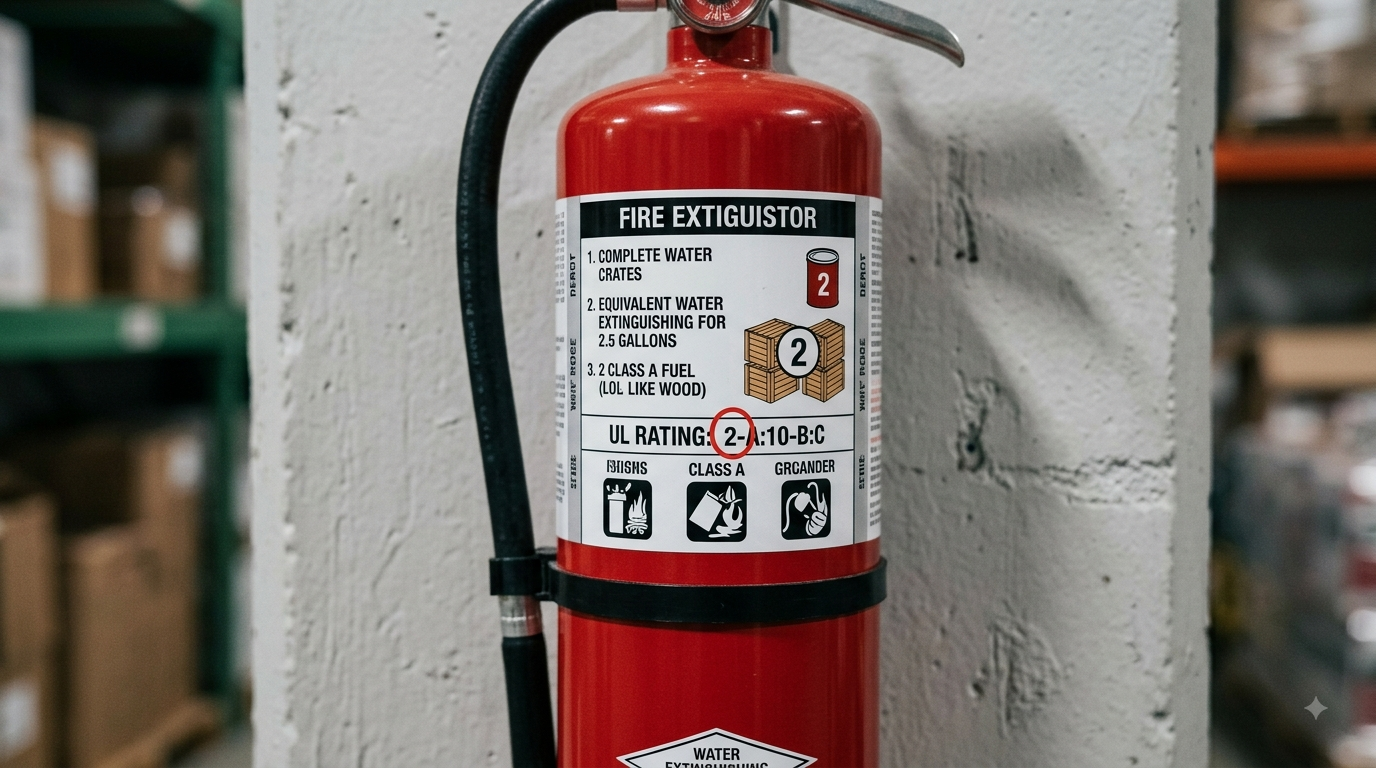
Before going deeper, it helps to establish the foundation. All fire extinguishers are labeled with a letter and a number, and each part of that label serves a distinct purpose. The letter (A, B, C, D, or K) tells you the class of fire the extinguisher is designed to fight. Class A covers ordinary combustibles like wood, paper, and cloth. Class B covers flammable liquids such as gasoline, oil, and grease. Class C covers fires involving live electrical equipment. Class D covers combustible metals, and Class K covers fires involving cooking oils and fats, typically found in commercial kitchens.
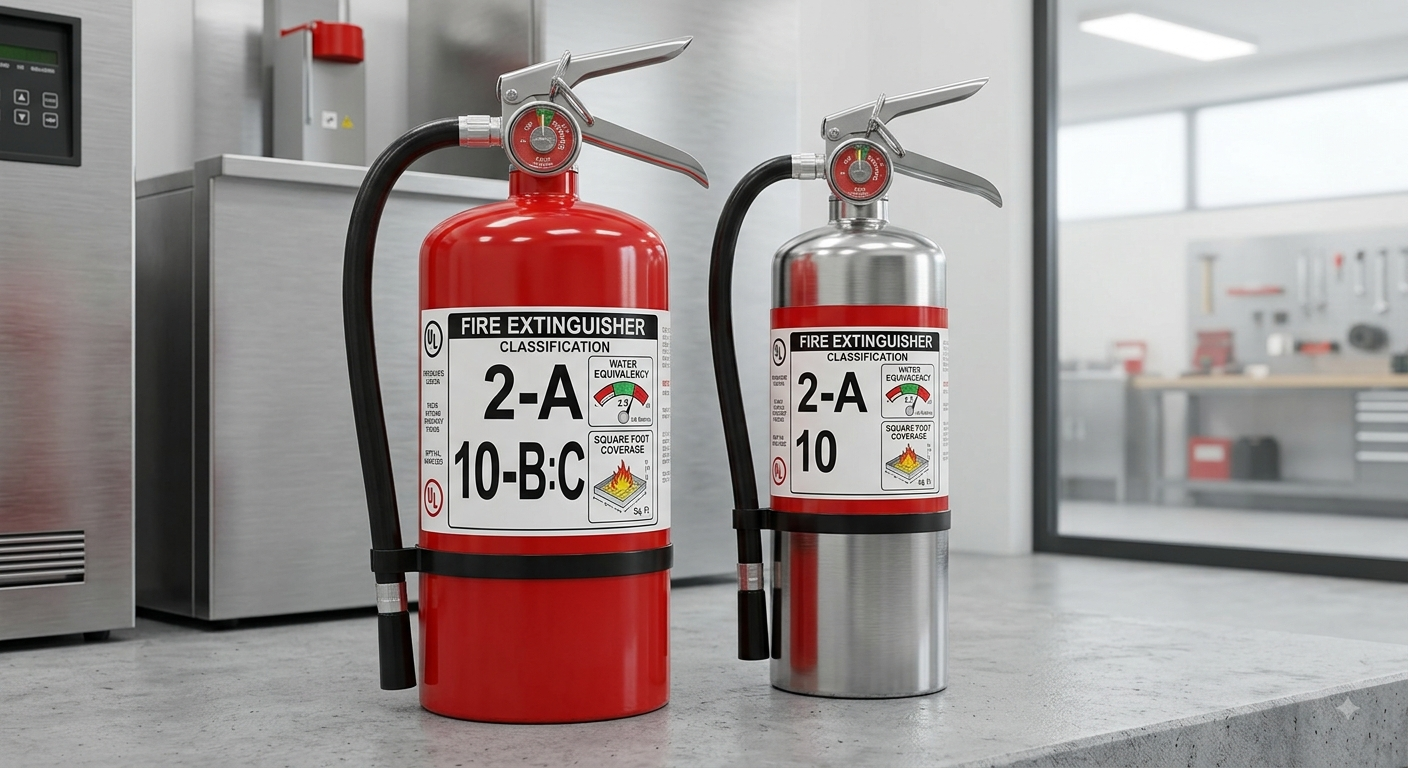
The number, on the other hand, indicates the extinguishing capacity or firefighting power of that particular unit for Class A and Class B fires. This is the part that trips up most people, and it is exactly what this article sets out to clarify. When you see a label like “4A:80B:C,” the number preceding the A tells you the water equivalency rating for extinguishing ordinary combustible fires, while the number preceding the B tells you the square footage of a flammable liquid fire the extinguisher can handle. In simple terms, the number indicates how much fire the extinguisher can put out, not the size of the canister or the amount of chemical agent inside it. A higher number means greater firefighting capacity, and understanding this distinction is central to selecting the right extinguisher for any environment.
A Brief History of Fire Extinguisher Classification
Fire suppression technology has come a long way since the earliest hand-pumped water grenades of the 18th and 19th centuries. Early firefighting tools were rudimentary, often consisting of little more than buckets of water, sand, or chemical mixtures thrown at flames with limited scientific backing. As industrialization spread and buildings grew taller and more complex, the need for standardized, reliable firefighting equipment became urgent.
The modern classification system we use today traces back to the work of organizations like the National Fire Protection Association (NFPA) and Underwriters Laboratories (UL) in the United States, which began formalizing fire classes and testing protocols in the mid-20th century. Before this standardization, extinguishers varied wildly in design and effectiveness, and there was no consistent way for a consumer or building inspector to know whether a given unit could actually handle the type of fire it might encounter. The introduction of the letter-and-number rating system solved this problem by creating a universal language for fire safety equipment, one that could be tested, verified, and trusted across industries and borders.
Over the decades, this system has been refined through rigorous laboratory testing. Extinguishers are evaluated by actually being used to put out controlled test fires of known size and intensity, and the results of these tests are what generate the numerical ratings you see on the label today. This historical development is worth understanding because it underscores that the number is not an arbitrary marketing figure. It is the product of decades of engineering research and empirical testing, refined to give end users an accurate, science-backed measure of what the device in their hands can actually do.
Why the Numerical Rating Matters So Much
It is easy to glance at a fire extinguisher and assume that bigger is always better, or that any extinguisher will do in a pinch. This assumption can be dangerous. The numerical rating exists precisely because not all extinguishers of the same class are created equal. Two Class A extinguishers might look similar in size, but one could be rated 2A while another is rated 4A, meaning the second unit has roughly double the firefighting capability of the first when facing ordinary combustible materials like wood or paper.
Understanding this rating becomes especially important in commercial and industrial settings, where fire codes often specify minimum extinguisher ratings based on the size and occupancy of a building. A small office might only require a 2A:10B:C extinguisher, while a large warehouse storing flammable materials might need units rated much higher to comply with local fire codes and insurance requirements. Getting this wrong is not just a compliance issue; it is a genuine safety risk. An undersized extinguisher in a large space can be quickly overwhelmed by a spreading fire, leaving occupants with a false sense of security and precious little time to evacuate safely.
How the Numbers Are Calculated for Class A and Class B Ratings
For Class A fires, the number is derived from water equivalency testing. In simplified terms, one unit of Class A rating is roughly equivalent to one and a quarter gallons of water in terms of extinguishing power. So a 4A-rated extinguisher has approximately the firefighting capacity of five gallons of water when applied to a wood crib fire under controlled test conditions. This might sound technical, but the practical takeaway is straightforward: a higher A-number means the extinguisher can knock down a larger ordinary combustible fire before it runs out of agent.
For Class B fires, the number represents the approximate square footage of a flammable liquid fire that a trained user could extinguish. A extinguisher rated 10B, for example, is tested against a fire covering roughly ten square feet of flammable liquid. A 40B unit is rated for a considerably larger flammable liquid fire, roughly four times the surface area. This distinction matters enormously in settings like auto repair shops, fuel storage facilities, and commercial kitchens, where flammable liquids are a constant hazard and undersized equipment could mean the difference between a contained incident and a catastrophic loss.
It is worth noting that Class C, Class D, and Class K ratings typically do not carry a numerical prefix the way A and B do. Class C simply indicates that the extinguishing agent is non-conductive and safe for use on live electrical equipment, riding alongside whatever A and B ratings the unit carries. Class D and Class K extinguishers are usually rated only by class because the testing standards for metal fires and cooking oil fires are fundamentally different from the water-equivalency and square-footage methods used for A and B.
Implementation in Real-World Settings
Knowing the theory behind fire extinguisher labels is one thing; applying that knowledge in real buildings and workplaces is another. Fire marshals, safety consultants, and facility managers use these letter-and-number combinations every day to determine appropriate extinguisher placement, spacing, and quantity throughout a structure. Building codes typically dictate not just what class of extinguisher is required in a given area, but also the minimum rating number, based on factors like the type of materials stored, the square footage of the space, and the distance an occupant would need to travel to reach the nearest unit.
For instance, in office environments dominated by paper, furniture, and general combustibles, a 2A-rated extinguisher might be sufficient for a modest-sized room, but as square footage increases, codes typically call for either additional units or extinguishers with higher A-ratings. In industrial settings involving solvents, fuels, or other flammable liquids, safety officers must pay particularly close attention to the B-rating, ensuring that the extinguisher capacity matches or exceeds the potential fire load in that specific area. Getting the implementation right requires more than just buying the biggest extinguisher available; it requires a genuine understanding of what those numbers mean and how they translate into actual firefighting performance.
Training also plays a huge role in effective implementation. Even the highest-rated extinguisher is only as useful as the person operating it. Most fire safety training programs teach the PASS technique (Pull, Aim, Squeeze, Sweep) alongside education on reading extinguisher labels, so that employees and residents alike know not just how to use the device, but whether it is even the right tool for the fire in front of them. This combination of correct equipment selection and proper training forms the backbone of any credible fire safety implementation strategy.
Impact Across Different Types of Facilities
The practical impact of correctly understanding extinguisher ratings varies significantly depending on the type of facility involved. In residential settings, homeowners often purchase a single multipurpose extinguisher rated for A, B, and C fires, which covers the majority of household fire risks including cooking fires, electrical fires, and general combustible fires. These home units are typically rated in the range of 1A:10B:C to 3A:40B:C, offering a reasonable balance of portability and firefighting capacity for a typical living space.
Commercial kitchens present a very different picture. These environments require Class K extinguishers specifically designed for the unique challenges of extinguishing burning cooking oils and fats, which behave very differently from ordinary flammable liquids and cannot be safely extinguished with standard B-rated equipment. The impact of choosing the wrong extinguisher in a commercial kitchen setting can be severe, as attempting to use water or an inappropriate agent on a grease fire can cause the fire to spread violently rather than being suppressed.
Large industrial complexes, warehouses, and manufacturing plants typically require a tiered approach, with different extinguisher classes and ratings positioned strategically throughout the facility based on localized fire risks. A section of a warehouse storing paper products might be equipped with high-rated Class A extinguishers, while an adjacent area used for equipment maintenance involving flammable solvents would need Class B units with substantially higher ratings. This zone-based approach to fire safety, guided entirely by an accurate understanding of what the letter and number combinations mean, has become standard practice across serious industrial safety programs.
Success Stories: When Proper Labeling Knowledge Saved the Day
There are countless documented cases where facility managers and trained employees successfully extinguished small fires before they escalated into major incidents, precisely because they understood the ratings on their equipment and selected the correct extinguisher for the situation. In manufacturing environments, workers trained to recognize Class B and Class D hazards have successfully contained metal shaving fires and solvent fires using appropriately rated equipment, preventing what could have been catastrophic losses to both property and life.
In the hospitality industry, hotel staff trained in fire safety protocols have used correctly rated Class A and Class K extinguishers to swiftly contain kitchen and laundry room fires, minimizing property damage and, more importantly, preventing injury to guests and staff. These success stories consistently share a common thread: the individuals involved understood not just how to operate a fire extinguisher, but specifically why the letter and number on the label mattered for the fire they were facing. This underlying knowledge transforms fire extinguishers from a mere legal requirement checked off during an inspection into a genuinely effective first line of defense.
Common Challenges and Misconceptions
Despite the clear logic behind the rating system, several persistent misconceptions continue to create risk. One of the most common misunderstandings is the assumption that a larger extinguisher canister automatically means a higher rating. In reality, extinguisher design, the specific extinguishing agent used, and manufacturing engineering all influence the final rating, meaning two extinguishers of similar physical size can carry very different numerical ratings depending on their internal formulation and design.
Another frequent challenge is inconsistent maintenance and inspection. An extinguisher’s rating reflects its capability when fully charged and properly maintained; a unit that has lost pressure, expired, or been damaged will not perform to its labeled rating regardless of what the tag says. Regular inspection schedules, typically monthly visual checks and annual professional servicing, are essential to ensuring that the rated capacity printed on the label remains accurate and reliable when an emergency actually occurs.
There is also widespread confusion between the letter classification and the numerical rating, with many people believing the number refers to the extinguisher’s weight or the volume of extinguishing agent inside. While there is some loose correlation, since larger extinguishers with more agent often do carry higher ratings, this is not a hard and fast rule, and relying on this assumption rather than checking the actual printed rating can lead facility managers to under-equip a space. Addressing these misconceptions through better training and clearer public education remains an ongoing challenge for fire safety professionals and manufacturers alike.
Comparing Fire Extinguisher Standards Across Regions
While the core concept that all fire extinguishers are labeled with a letter and a number is broadly consistent, the specific testing standards and classification systems do vary somewhat between countries. The United States relies heavily on NFPA 10 and UL rating standards, which is the system described throughout most of this article. The European Union uses a somewhat different classification under EN 3, which includes Class A, B, C, D, and F (the European equivalent of the American Class K for cooking oil fires), with its own distinct testing methodology for determining extinguishing capacity.
Despite these regional differences in testing protocols, the underlying philosophy remains remarkably consistent worldwide: extinguishers should be classified by the type of fuel they can safely extinguish, and their firefighting capacity should be quantified through standardized, independently verified testing rather than manufacturer claims alone. This global consensus around science-based classification has made it considerably easier for multinational companies, safety consultants, and equipment manufacturers to maintain consistent safety standards across international operations, even when local regulatory bodies differ in their specific testing procedures.
Fire Extinguisher Ratings Compared to Other Safety Measures
It is useful to place fire extinguisher rating comprehension within the broader context of overall fire safety strategy. Extinguishers are just one layer within a much larger fire protection framework that typically includes smoke detectors, sprinkler systems, fire-resistant building materials, clearly marked emergency exits, and comprehensive evacuation planning. Unlike automatic sprinkler systems, which respond to fire without requiring human intervention, extinguishers demand that someone present understands both how to operate the device and whether its rating is sufficient for the fire at hand.
This is precisely why extinguisher labeling knowledge cannot be treated as a standalone safety measure. It functions best as part of an integrated approach where building occupants are trained not only in extinguisher use but also in recognizing when a fire has grown beyond what a portable extinguisher, regardless of its rating, can safely handle. Fire safety experts consistently emphasize that extinguishers are intended for small, incipient-stage fires. Once a fire has grown beyond the capacity indicated by even the highest-rated extinguisher, immediate evacuation and professional firefighting intervention become the only safe course of action.
The Future of Fire Extinguisher Technology and Labeling
As building materials, energy storage systems, and consumer products continue to evolve, so too does the science behind fire classification and extinguisher design. The rapid growth of lithium-ion battery usage in everything from smartphones to electric vehicles has introduced new firefighting challenges that traditional class systems were not originally designed to address. Fire safety organizations are actively researching and developing updated standards and, in some cases, entirely new extinguisher classes to address these emerging hazards effectively.
Looking ahead, we can expect continued refinement of testing methodologies, potentially more granular rating systems that offer even more precise guidance for specialized environments, and greater integration of smart technology into fire safety equipment. Some manufacturers are already exploring extinguishers embedded with pressure sensors and connectivity features that can alert facility managers when a unit’s charge drops below optimal levels, ensuring that the printed rating remains an accurate reflection of real-world performance at all times. As these innovations mature, the fundamental principle will remain unchanged: all fire extinguishers are labeled with a letter and a number so that anyone, regardless of technical background, can make an informed, split-second decision about whether their equipment is up to the task in front of them.
Practical Tips for Reading and Choosing the Right Extinguisher
When evaluating a fire extinguisher for your home, office, or facility, start by identifying the specific fire risks present in that environment. A kitchen needs Class K or a multipurpose ABC unit near cooking areas, while a garage or workshop with flammable liquids needs a strong B-rating. Always check that the numerical rating meets or exceeds any applicable local fire code requirements, and when in doubt, consult a licensed fire safety professional who can assess your specific space and recommend appropriate coverage.
It is equally important to verify that any extinguisher you purchase or maintain has been tested and certified by a recognized authority such as UL or an equivalent international body. Certification ensures that the letter and number combination printed on the label has actually been verified through standardized testing rather than simply claimed by the manufacturer. Regular maintenance checks, proper wall mounting at accessible heights, and periodic staff training all work together to ensure that the rating on the label translates into real protective capability when it matters most.
Conclusion
Fire extinguisher labels might seem like a small detail buried among dozens of other safety requirements, but they represent decades of scientific testing condensed into a simple, universally understood format. All fire extinguishers are labeled with a letter and a number, and now you understand precisely what that number indicates: the measurable firefighting capacity of the unit for Class A and Class B fires, derived from rigorous water-equivalency and square-footage testing standards. Whether you are a homeowner choosing your first extinguisher, a facility manager responsible for code compliance across an entire industrial complex, or simply someone who wants to be prepared in an emergency, understanding this rating system empowers you to make genuinely informed safety decisions rather than relying on guesswork. As fire safety technology continues to advance, this foundational knowledge will remain just as relevant, ensuring that the right tool is always within reach when seconds truly count.