How Long Does It Take for a Cavity to Form? A Complete Guide to Tooth Decay Timelines, Causes, and Prevention
Most people assume a cavity appears overnight one day their tooth feels fine, the next it aches after a sip of cold water. In reality, tooth decay is a slow, layered process that unfolds over weeks, months, or even years before it becomes a full-blown hole in your enamel. Understanding how long it takes for a cavity to form isn’t just a matter of dental trivia; it shapes how seriously we take our brushing habits, how often we visit the dentist, and how early we catch problems before they turn into root canals. This guide walks through the entire lifecycle of a cavity, the science behind enamel breakdown, the factors that speed up or slow down decay, and what you can do at every stage to protect your smile.
Understanding What a Cavity Actually Is
Before we can talk about timelines, it helps to understand what’s actually happening inside your mouth. A cavity, medically referred to as dental caries, is permanent damage to the hard surface of a tooth caused by acids produced when bacteria break down sugars and starches left behind on your teeth. Your mouth is home to hundreds of species of bacteria, and many of them are harmless or even beneficial. But certain strains, particularly Streptococcus mutans, thrive on sugar and produce acid as a byproduct of digestion. This acid attacks the mineral structure of your enamel, the hard outer shell that protects the softer, more vulnerable layers of the tooth underneath.
When people ask how long does it take for a cavity to form, they’re really asking how long it takes for this acid attack to overpower your tooth’s natural defenses. The answer isn’t a single number because it depends on a web of interacting factors: how often you eat sugary foods, how well you brush and floss, whether your saliva can neutralize acid quickly, whether you use fluoride, and even your genetics. That said, dental researchers have mapped out fairly consistent stages that most cavities pass through, and knowing them gives you a realistic picture of the timeline.
The Science Behind Tooth Decay: Why It Happens at All
Every time you eat or drink something containing sugar or refined carbohohydrates, the bacteria in the plaque coating your teeth begin fermenting it almost immediately. This process produces acid within about twenty minutes of eating, and that acid lowers the pH on the surface of your tooth enough to start pulling minerals like calcium and phosphate out of the enamel. This is called demineralization. Fortunately, your saliva contains its own minerals and buffering agents, and over the next thirty to sixty minutes it works to neutralize the acid and redeposit some of those lost minerals back into the enamel — a process called remineralization.
In a healthy mouth with good oral hygiene, demineralization and remineralization exist in a rough balance, and your enamel stays intact. Cavities form when this balance tips too far toward demineralization for too long, usually because of frequent snacking, prolonged sugar exposure, inadequate brushing, or insufficient fluoride to help rebuild the enamel. Over repeated cycles, the mineral loss outpaces the repair, and the enamel structure begins to break down at a microscopic level long before you would ever notice a visible spot or feel any pain.
The Stages of Cavity Formation and Their Timelines
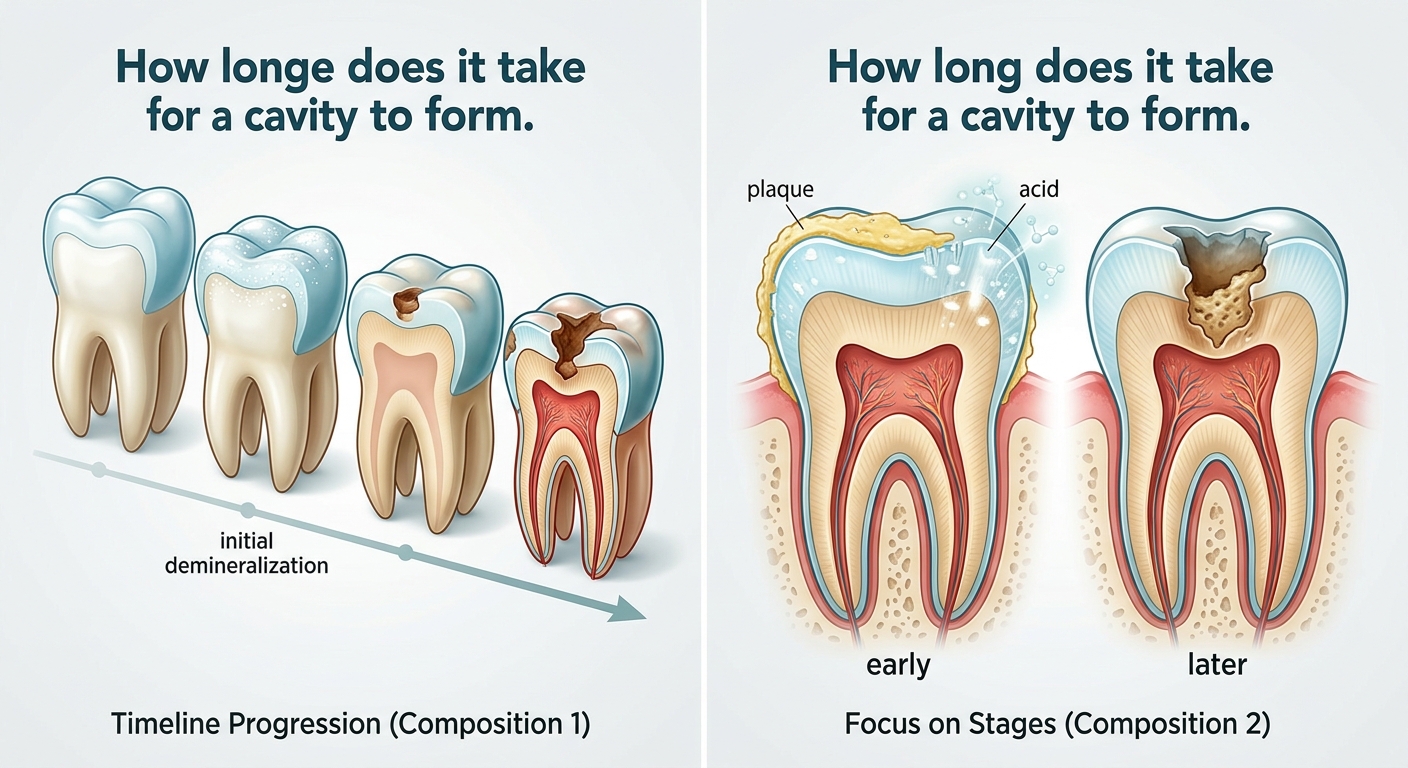
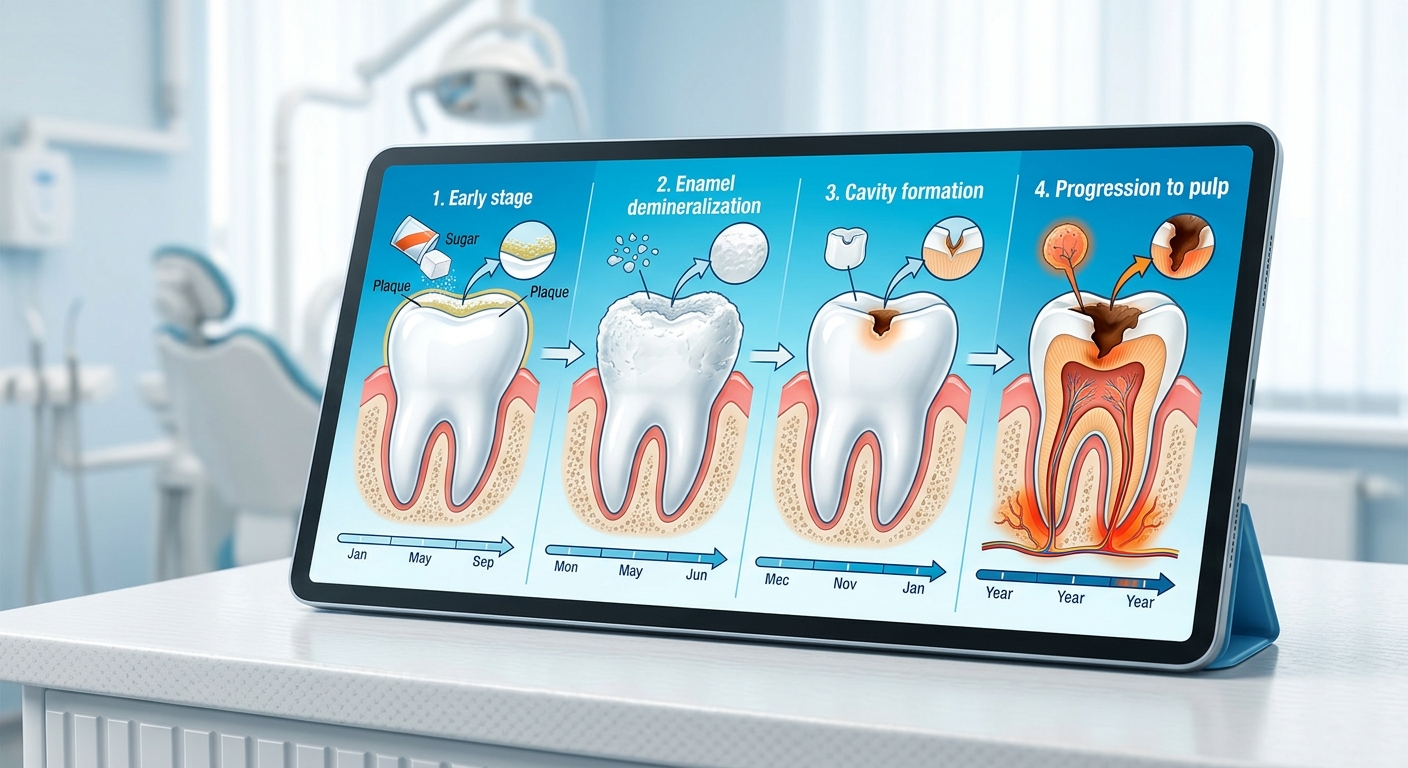
Stage One: Initial Demineralization (Weeks to a Few Months)
The very first sign of a developing cavity is a small white or chalky spot on the tooth surface, often near the gumline or in the grooves of molars. This is enamel that has begun losing minerals but hasn’t yet broken down structurally. At this stage, the damage is often reversible. With consistent fluoride exposure, improved brushing, and reduced sugar intake, the tooth can remineralize and the white spot can fade. This early phase can develop in as little as a few weeks of poor oral hygiene, though for most people it takes several months of repeated acid exposure before it becomes noticeable.
Stage Two: Enamel Decay (Several Months to a Few Years)
If demineralization continues unchecked, the enamel surface starts to physically erode, creating a small pit or soft spot. Because enamel is the hardest substance in the human body, this stage tends to progress slowly. It commonly takes anywhere from six months to two years for decay to move from the earliest surface changes to an actual breach of the enamel layer, though the exact pace depends heavily on diet and hygiene. This is usually the point at which a dentist can detect the cavity on an X-ray or during a routine check-up, even before you feel any discomfort yourself.
Stage Three: Dentin Decay (Faster Progression, Often Just Months)
Once decay breaks through the enamel and reaches the dentin — the softer, more porous layer beneath — the pace of destruction accelerates significantly. Dentin doesn’t have the same mineral density as enamel, so bacteria can spread through it far more quickly. At this stage, a cavity that took a year or two to reach the dentin might progress to the point of causing sensitivity or mild pain within just a few months. This is typically when people start noticing symptoms like sharp twinges when eating something sweet, hot, or cold.
Stage Four: Pulp Involvement (Weeks to a Few Months)
If the decay is still not treated, it eventually reaches the pulp chamber at the center of the tooth, where the nerves and blood vessels live. This is the stage associated with serious, persistent toothaches, swelling, and sometimes infection or abscess formation. Because the pulp is soft, vascular tissue, decay can tear through it relatively fast once it arrives — often within a matter of weeks to a couple of months after dentin involvement, especially if the bacteria have a clear path inward. At this point, treatment options narrow considerably, often requiring root canal therapy or extraction rather than a simple filling.
Putting It All Together: A Realistic Overall Timeline
So, how long does it take for a cavity to form from start to finish? For most people, the complete journey from the very first demineralized spot to a cavity requiring a filling takes somewhere between six months and five years. Small children and people with weakened enamel, dry mouth, or very high-sugar diets can see this timeline compressed dramatically, sometimes developing cavities in a matter of months. On the other hand, people with strong oral hygiene routines, fluoride exposure, and lower sugar consumption may have tiny areas of demineralization that never progress into an actual cavity at all, staying dormant or even reversing over years.
It’s worth emphasizing that this is not a linear countdown ticking away in the background. A tooth can sit at the “early white spot” stage for a long time if conditions stay favorable, or it can rapidly worsen if habits change — say, a person starts drinking sugary soda daily or stops brushing consistently. This is precisely why the question of how long a cavity takes to form doesn’t have one universal answer; it’s a range shaped by daily choices repeated over time.
A Brief History of How We Came to Understand Cavities
Tooth decay is not a modern invention. Archaeological evidence shows cavities in human remains dating back tens of thousands of years, though the rate of decay in ancient populations was generally lower because diets contained far less refined sugar. The chemical understanding of cavity formation as an acid-driven process only became clear in the late nineteenth century, when researchers began linking bacterial activity and sugar fermentation to enamel breakdown. Over the twentieth century, the introduction of fluoride toothpaste and fluoridated community water supplies dramatically slowed the average pace of decay across entire populations, cutting cavity rates by a significant margin in many countries.
Modern dentistry has refined this understanding even further with high-resolution imaging, allowing dentists to detect demineralization at stages invisible just a few decades ago. This historical progression matters because it shows that the timeline for cavity formation isn’t fixed biology alone — it’s also a product of public health tools, oral hygiene habits, and access to preventive dental care, all of which have shifted the average pace of decay over generations.
Objectives Behind Understanding Cavity Timelines
Knowing how long it takes for a cavity to form serves several practical purposes. First, it helps patients understand why regular six-month dental check-ups matter: this interval is specifically designed to catch cavities at the enamel stage, before they progress into painful dentin or pulp involvement. Second, it reinforces why consistent daily habits matter more than occasional intense cleaning sessions — since demineralization and remineralization happen continuously throughout the day, sporadic care leaves long windows for acid damage to accumulate. Third, understanding the timeline helps parents recognize that children’s teeth, with their thinner enamel, are especially vulnerable to a faster decay process, making early habit-building essential.
How Cavities Are Actually Diagnosed at Each Stage
Dentists rely on a combination of visual examination, tactile probing, and X-ray imaging to determine exactly where a cavity sits along its developmental timeline. Early white-spot lesions are often visible simply by drying the tooth surface and looking closely under good lighting. Enamel-stage cavities frequently show up on bitewing X-rays as small dark triangles before they’re visible to the naked eye. Once decay reaches the dentin, X-rays show a more pronounced shadow, and the patient often reports sensitivity that prompts the visit in the first place. Diagnostic tools like laser fluorescence devices and digital imaging have made it possible to catch decay at increasingly early points, effectively giving dentists a window to intervene before a filling is even necessary.
Factors That Speed Up Cavity Formation
Several elements can dramatically shorten the timeline of cavity development. Frequent snacking on sugary or starchy foods keeps the mouth in a near-constant acidic state, denying enamel the recovery window it needs. Dry mouth, whether from medication, dehydration, or certain medical conditions, reduces the saliva available to neutralize acid and redeposit minerals. Poor brushing technique or infrequent brushing allows plaque to build up undisturbed, giving bacteria more time and material to produce acid. Deep grooves in molars, overlapping teeth, and old fillings with rough edges create hiding spots where plaque escapes regular cleaning. Additionally, acidic beverages like soda, sports drinks, and fruit juice erode enamel directly, compounding the damage caused by bacterial acid alone.
Factors That Slow Down or Prevent Cavity Formation
On the flip side, a number of habits and conditions can stretch out or even halt the progression of early decay. Regular use of fluoride toothpaste strengthens enamel and actively encourages remineralization, often reversing early white-spot lesions entirely. Drinking fluoridated tap water provides a steady, low-level source of protection throughout the day. Chewing sugar-free gum after meals stimulates saliva flow, speeding up the natural acid-neutralizing process. Reducing the frequency of sugar intake — even without eliminating sugar entirely — gives teeth more recovery time between acid attacks, since it’s the frequency of exposure, not just the total amount, that matters most. Dental sealants, thin protective coatings applied to the chewing surfaces of molars, physically block plaque and acid from reaching vulnerable grooves, often preventing decay from starting at all in those areas.
Regional and Lifestyle Variations in Cavity Development
Interestingly, the pace at which cavities form isn’t uniform across populations. Communities with fluoridated water supplies consistently show slower average decay rates and fewer cavities overall compared to areas relying solely on non-fluoridated sources. Diets vary regionally too — populations with higher consumption of processed sugars and carbonated beverages tend to see faster cavity progression, while diets richer in whole foods and lower in refined sugar are associated with slower decay rates. Access to routine dental care also plays a significant role: areas with limited availability of dentists, whether due to rural geography or economic barriers, often see cavities detected later, by which point they’ve already progressed well beyond the early, reversible stage. Public dental health outreach programs, school-based screening initiatives, and community water fluoridation efforts have all been shown to shift these regional patterns over time, narrowing the gap between areas with strong preventive infrastructure and those without it.
Success Stories: How Early Detection Changes Outcomes
Consider two hypothetical but realistic scenarios that reflect what dentists see routinely. In the first, a patient attends consistent six-month check-ups. A small white spot is caught on a molar during a routine exam. The dentist recommends a fluoride varnish treatment and better flossing around that tooth. Six months later, at the next visit, the spot has remineralized and is barely visible — no filling was ever needed, and no time or money was spent on restorative treatment. In the second scenario, a patient skips dental visits for several years. By the time sensitivity finally prompts an appointment, the decay has already reached the dentin and is approaching the pulp. What could have been a simple, inexpensive intervention now requires a filling or possibly a root canal, along with a longer and more costly recovery process. These contrasting outcomes illustrate why understanding the cavity formation timeline isn’t just academic — it directly influences the cost, discomfort, and complexity of treatment.
Common Challenges in Catching Cavities Early
Despite growing awareness, several obstacles make early detection harder than it should be. Cavities in their earliest stages are often painless, so there’s no natural signal prompting a person to seek care — by the time pain appears, decay has usually already reached the dentin. Cost and access barriers mean that regular preventive visits, which are the primary way early-stage cavities get caught, aren’t equally available to everyone. Children and teenagers, whose enamel is thinner and more porous than adult enamel, can experience a compressed timeline where a cavity progresses from first appearance to requiring treatment far faster than in adults, catching parents off guard if visits are infrequent. Additionally, some people mistakenly believe that if a tooth doesn’t hurt, nothing is wrong, delaying visits until the decay has already advanced significantly.
Comparing Cavities to Other Dental Conditions
It’s useful to place cavity formation alongside other common dental issues to understand how it differs. Gum disease, for instance, follows a different bacterial pathway, targeting the soft tissue and bone supporting the teeth rather than the enamel itself, and its progression is often slower and more insidious in its early gingivitis stage. Enamel erosion, caused by acidic foods and drinks rather than bacterial activity, can actually progress faster than a typical cavity in people with highly acidic diets, since it doesn’t require the bacterial fermentation step that traditional decay does. Tooth sensitivity from worn enamel or exposed roots can mimic the symptoms of a cavity but stems from a completely different mechanism, usually mechanical wear rather than bacterial acid attack. Recognizing these distinctions helps patients and dentists tailor prevention strategies appropriately, since what slows a cavity — fluoride and reduced sugar frequency — isn’t necessarily what addresses erosion or gum disease as effectively.
The Role of Diet in Determining How Fast a Cavity Develops
Diet remains one of the single biggest variables affecting how long it takes for a cavity to form. Sticky, sugary foods that cling to tooth surfaces — caramel, dried fruit, certain candies — extend the amount of time sugar sits in contact with teeth, giving bacteria a longer feeding window than something that’s swallowed quickly. Beverages sipped slowly over long periods, like sugary coffee drinks or soda consumed throughout a workday, bathe teeth in a near-continuous acidic environment, which can accelerate decay far more than the same amount of sugar consumed in one quick sitting. Conversely, foods that stimulate saliva production, such as crunchy vegetables and cheese, can help offset some of this acid exposure by encouraging the mouth’s natural defense mechanisms. This is why dental professionals often emphasize not just what you eat, but how and when you eat it, as a determining factor in cavity progression speed.
Children Versus Adults: Different Timelines Entirely
Because baby teeth have thinner enamel and smaller dentin layers than permanent teeth, cavities in children can progress from initial demineralization to requiring treatment considerably faster than in adults — sometimes within just a matter of months rather than years. This is part of why pediatric dentists recommend earlier and more frequent check-ups for young children, along with preventive measures like sealants and fluoride varnish applied proactively rather than reactively. Adults, particularly those with strong enamel and consistent oral hygiene, often see a much slower march from first symptom to serious decay, sometimes stretching over several years. However, older adults face their own accelerating factors, including receding gums that expose the softer root surface (which lacks the protective enamel coating altogether) and age-related dry mouth from medications, both of which can speed up decay in ways that mirror childhood vulnerability.
Future Prospects: Where Cavity Detection and Prevention Are Headed
Dental technology continues to shift how early cavities can be caught and how effectively their progression can be halted. Emerging diagnostic tools using near-infrared imaging and AI-assisted X-ray analysis are helping dentists spot demineralization even earlier than traditional visual exams allow, catching problems while they’re still fully reversible. Remineralizing agents beyond standard fluoride, including compounds like calcium phosphate pastes, are being incorporated into more toothpaste and professional treatments, offering additional tools to nudge the demineralization-remineralization balance back in favor of tooth strength. Teledentistry and at-home screening kits are also expanding access to preventive guidance in areas where in-person dental care is harder to reach, potentially narrowing some of the regional gaps in cavity outcomes discussed earlier. As these tools mature, the overall trend points toward catching cavities earlier in their timeline and intervening before they ever require a drill, shifting dentistry further toward prevention rather than repair.
Practical Steps to Slow Down or Stop a Cavity From Forming
If you’re wondering how long it takes for a cavity to form because you’ve noticed early warning signs, the most effective response is to act during the reversible window. Brushing twice daily with fluoride toothpaste, flossing once a day to disrupt plaque between teeth, and limiting how often (not just how much) sugary food and drink you consume all directly influence the pace of demineralization. Scheduling dental check-ups every six months ensures that if a cavity is developing, it’s caught while it’s still confined to the enamel and can potentially be reversed rather than filled. Using a fluoride mouth rinse, especially for people prone to dry mouth or with a history of frequent cavities, adds another layer of protection between meals. These steps won’t guarantee that a cavity never forms, but they meaningfully extend the timeline and increase the odds that early decay gets caught before it becomes a bigger problem.
Final Thoughts on Cavity Formation Timelines
The honest answer to how long does it take for a cavity to form is that it depends — but understanding the general stages gives you a real framework to work with. Early demineralization can begin within weeks of poor habits, enamel breakdown typically unfolds over months to a couple of years, and once decay reaches the dentin, the pace accelerates, often bringing symptoms and requiring treatment within months rather than years. The overall journey, from the very first invisible mineral loss to a cavity requiring a filling, most commonly spans somewhere between six months and five years, shaped heavily by diet, hygiene, fluoride exposure, and access to regular dental care. Armed with this knowledge, the best strategy isn’t to fear a ticking clock but to build consistent daily habits and routine check-ups that keep the demineralization-remineralization balance tipped in your favor for as long as possible.
Frequently Asked Questions
Can a cavity form in just a few days?
It’s extremely unlikely for a full cavity to develop in a matter of days. What can happen quickly is the very beginning of demineralization, but turning that into an actual structural cavity typically takes weeks to months at minimum, even under poor oral hygiene conditions.
Is it possible to reverse a cavity once it starts forming?
Yes, but only during the earliest stage, when the damage is limited to enamel demineralization and hasn’t yet caused a physical break in the tooth surface. Fluoride treatment, improved hygiene, and reduced sugar exposure can help remineralize enamel at this point. Once a cavity breaks through into the dentin, it cannot be reversed and requires a filling.
Why do cavities seem to appear suddenly even with regular brushing?
Cavities often develop in hard-to-reach spots like between teeth or in deep molar grooves, where brushing alone may not fully remove plaque. Because early decay is painless, it can progress silently for months before becoming noticeable, giving the impression of a sudden appearance.
Do children’s cavities really form faster than adult cavities?
Generally, yes. Children’s baby teeth have thinner enamel and dentin layers compared to permanent adult teeth, which allows decay to progress from initial signs to a treatable cavity more quickly, sometimes within just a few months.
How often should I see a dentist to catch cavities early?
Most dental professionals recommend a check-up every six months. This interval is specifically chosen because it aligns with the typical pace at which early-stage cavities progress, giving dentists a reasonable window to catch and address problems before they advance.
Does sugar always cause cavities, or does it depend on other factors?
Sugar alone doesn’t guarantee a cavity; it’s the frequency and duration of sugar exposure combined with oral hygiene and fluoride use that determines whether decay actually progresses. Someone who eats sugar occasionally but brushes and flosses consistently may never develop a cavity from it, while frequent sipping or snacking on sugar throughout the day creates far more opportunity for decay.
Can stress or overall health affect how fast a cavity develops?
Indirectly, yes. Conditions that reduce saliva flow, such as certain medications, dehydration, or specific medical conditions, can accelerate cavity formation because saliva plays a central role in neutralizing acid and remineralizing enamel. Poor overall health habits, including inconsistent hygiene during stressful periods, can also indirectly speed up decay.